
Introducing the Waggle Method of Learning: a field guide to finding truth in human health and nutrition
Learning from bees: decentralized methods of information verification in the digital age

What if you had a simple field guide to tell good human nutrition signals from noise? Bees do, and it’s elegant. It’s called a “waggle dance.” It is a compact language that helps a hive find, verify, and exploit food sources. Here, I’m borrowing that playbook. I call it The Waggle Method of Learning. I’ll outline eight rules you can use to judge scientific claims the way a hive judges their own data to delineate what is true and what is not.
In the information age, we are subjected to more data and opinions than ever before which need to be processed, categorized and either acted upon or dismissed. For example, how do we really know what the most optimal diet and lifestyle habits are to promote human health? We don’t have the time or energy to verify and test all data we receive ourselves, so how can we make the correct decisions? How can we verify truth and find the signal above the noise for complex issues? To answer those questions, and more, we may be able to derive some lessons from how the bees communicate to each other.
How do honeybees communicate to others where good sources of food are? This central question has baffled scientists since it was first observed by Aristotle, more than 2000 years ago, where he wrote:
Thanks for reading Homo op(t)imus! Subscribe for free to receive new posts and support my work.
“On each trip the bee does not fly from a flower of one kind to a flower of another, but flies from one violet, say, to another violet, and never meddles with another flower until it has got back to the hive; on reaching the hive they throw off their load, and each bee on her return is followed by three or four companions... what it is that they gather is hard to see, and how they do it has not been observed.”
— Aristotle
Today this phenomenon has been verified and is described as flower consistency. But how do they communicate where to go and which flowers are good, bringing back more bees to that same food source? It turns out the honeybees have a secret communication method to convey information. This mystery was first decoded by Karl von Frisch in 1927, a discovery for which initially brought ridicule from other scientists but one he went on to win the Nobel Prize for in 1973. Von Frisch discovered that honeybees use dance to convey information about the location and distance of food sources. He showed that different types of dances, so-called “waggle dances,” convey information about food sources such as the distance, direction, type and quality. For example, Von Frisch also found that the angle of the dancing bee in relation to gravity corresponds to the angle of the direction of the food in relation to the sun.
When Frisch began studying bees in 1912, he had a hypothesis that the bees’ waggle dance was a form of language. The pursuit of this ran counter to prevailing wisdom and core assumptions of Western science and philosophy. At that time, many assumed that only humans have complex forms of language, and that insects were incapable of complex communication since they have tiny brains.
“Miraculous worlds may reveal themselves to a patient observer where the casual passerby sees nothing at all.”
— Karl von Frisch
In contrast to human language, it turns out bee language is mostly spatial and vibrational. The type, frequency, angle and amplitude of vibrations made by the bees’ bodies, including their abdomens and wings, contain information which can be decoded by every bee. Through these buzzing, and quivering movements, bees communicate remarkably accurate information. Once a scout bee has found a good food source, it returns to the hive to inform the others. It does this by dancing. During the waggle dance, the bee moves in a specific figure-eight pattern; a straight line while beating wings, and then a circular return without wing beating. We know now that the resulting pattern, which can be observed visually, encodes the direction to the food source relative to the sun’s position in the sky.
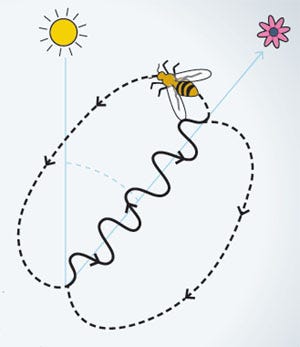
But exactly what information is encoded and how? To discover this, Frisch had to painstakingly track thousands of individual bees to analyze the correlation between their dances and specific food sources. To many, this seemed impossible, given that hive populations have thousands of bees. However through enough patience, he was able to prove his hypothesis. How it works is a lead bee dancer waggles, they orient their body relative to gravity and the position of the sun. By making subtle variations in the length, speed and intensity of the dance, the bee is able to give precise instructions about the direction, distance and quality of the nectar source. In so doing, they teach the other bees in the hive, who use the information they have learned from the waggle dance to fly to a nectar source they have never before visited.
In a famous experiment, he trained his bees to navigate to a hidden food source that was miles away, across a lake and around a mountain, an astonishing feat, given that he had shown the food source once to only a single bee. In another experiment, he demonstrated that different hives have slightly altered dancing patterns. Bees appeared to learn these patterns from their hive mates. In essence, honeybee dance language has dialects, similar to human communities.
Frisch himself was so amazed by his findings that he initially kept them secret. Contradicting prevailing scientific views, his findings demonstrated that honeybees possessed learning, memory and the ability to share information through symbolic communication, a form of abstract language. Now known as a kind of swarm intelligence. When he finally went public, many scientists dismissed his research and argued that insects with such tiny brains were incapable of complex communication. Eventually, Frisch’s results were definitively and independently validated, and he was awarded the Nobel Prize in 1973. The prize committee concluded its nomination statement by referring to the “shameless vanity” of us humans that refused to recognize bees’ extraordinary capacities.
The waggle dance is still considered by many scientists to be the most complex symbolic system that humans have decoded to date in the animal world. But mysteries about it remain. Through research, we are still learning lots about the subtleties of the waggle dance. While the rules may be encoded through physics and chemistry, from a social standpoint the context of the dance matters to the outcome of the information conveyed. Here are 8 principles to consider for every waggle dance which encodes information:
1) Experience matters
The age and experience of the bee doing the waggle dance has a bearing on whether other bees will listen to it. Bees in the hive have a shared memory of the experience and age of each bee performing a waggle and this can be used as a heuristic for the quality of the data on the food source.
2) Replication and work matters, as not every dance is convincing or acted upon
The number of times the waggle dance is repeated by the bee can indicate to others the excitement the bee has for the food source, thus the quality of the food source and whether the other bee will listen and follow. Other bees observe the dance and can assess its quality. A strong, precise dance indicates a valuable food source, while a weak or imprecise dance might suggest a less promising source. Information in a waggle dance is not always followed; some bees observe over 50 waggle runs without foraging while others will after 5 and bees may only make use of the information in the waggle dance about 10% of the time on average.
3) Context and environment matters
The waggle dance is more beneficial in some environments compared to others, and is more common when food sources are not as abundant. Bees are more likely to act upon imprecise data or signals with less quality if food is not abundant at that moment. If what is currently happening is not working then edge cases are taken more seriously.
4) Independent verification reigns supreme
Foragers prefer to use remembered information about a previously rewarding food site they visited even when observing a dance about another food source. Thus sometimes following social information is more energetically costly than foraging independently and is not always advantageous.
5) Listen when it’s more advantageous
Bees are more likely to switch to the public information about a food source through a waggle dance when their private information is no longer useful. This highlights the importance of personal experience as the ultimate truth to ones behavior but only if that experience is proving useful.
6) An interoperable and universal communication method
Each honeybee has different dialects of the waggle dance, varying by curve and duration but Asiatic honeybees and European honeybees were gradually able to understand each other’s “dialects” of the waggle dance. This indicates convergent evolution of this method of having a shared truth to information as vital as finding food to keep the hive alive.
7) Information is encoded through electrical signals
Physics is the base layer to biology. Likely how the waggle dance conveys information is an electric charge can accumulate in bees during flying as their body parts are rubbed together. This is emitted during the waggle dance and these electric fields can be sensed through mechanoreceptors in other bees. We have to remember there are invisible forces all around us that could be influencing behavior and biology at an atomic level not just the level of a cell or molecule.
8) Mysteries remain
We need to be humble about what we think we know in science and open to new ideas. For example, can every bee in the hive know the direction and how? New research suggests that the neural circuits of the other bees observing the waggle dance can interpret the dance vector from any position around the dancer, using the angle of their antennae to detect their relative orientation. But still many unknowns remain on how this happens and it could be something completely different we do not yet understand.
In these 8 concepts, one can already begin to draw metaphors to the human experience. Upon reflection, learning of the intricacies of the waggle dance could be more than just a theoretical curiosity; there are many concepts here that provide useful analogies to human communication and our search for truth, verification in the AI and information age. In an adversarial environment where data and information are non-limited, how do we search for truth, verify it and communicate it? What principles could be required? What is good information and what is misinformation? How do we know which food is best and where is it? As humans spend time and energy to convey information about the quality and types of food to eat, and other scientific information, we could learn a lot from the waggle dance.
With trust of centralized scientific and governmental authorities at a low, there may be answers to some complex issues within the wisdom of the crowds- a swarm intelligence that is decentralized.
One place this is desperately needed in my opinion is in the realm of human nutrition. More humans are living with chronic diseases than ever before. Maybe we can learn something by how bees feed themselves to teach us how to feed ourselves to be healthy again.
Of all the controversies in nutrition, our societal misunderstanding of the role of lipid biology in human health is a good place to start. For example, we live in a world where many people still think cholesterol is “bad” and saturated fat is “unhealthy” and factory processed vegetable oils are “heart healthy.” These beliefs have a monumental impact on us as a human species, and result in a misinformed population with huge consequences for our health.
What are all the ways the lipids we consume effect human biology?
Let’s go on a journey together to figure this out, while staying humble and curious about the mysteries all around us.